Jerit Mitchell was an undergraduate when he showed his supervisors an odd structure in a scan of a dinosaur rib. He hadn’t given it much thought, he later recalled, but they suggested he might have found preserved blood vessels.
The rib belonged to Scotty, the largest Tyrannosaurus rex skeleton ever discovered. Inside the 66-million-year-old bone was a mineralized network of blood vessels that grew around the break as Scotty’s rib began to heal.
Mitchell is now a physics doctoral candidate at the University of Regina and leads the project. In April 2026, the research team used neutron imaging at Oak Ridge National Laboratory (ORNL) to examine Scotty’s rib without cutting into it. The images supported the earlier X-ray findings and showed the inside of the rib in 3D.
"There are more fossils than you think sitting in collections, hiding secrets from millions of years ago," Mitchell said in a press release. “Putting them in a synchrotron or neutron source allows us to make new discoveries about ancient life like never before."
Blood Vessels Inside Scotty’s Broken Rib
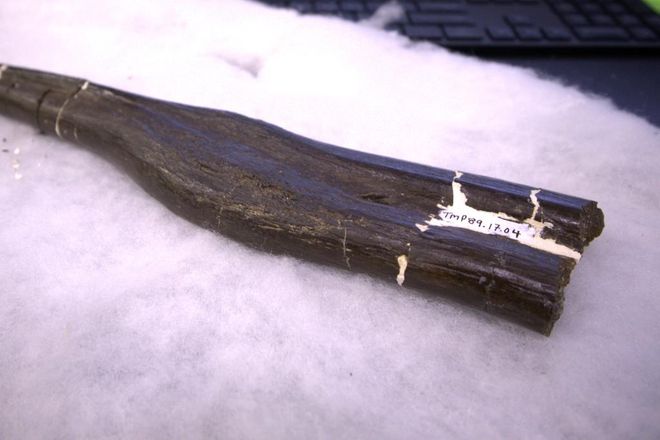
Hadrosaur rib from the Royal Tyrrell Museum fossil collection
(Image Courtesy of Sumner Brown Gibbs/ORNL, U.S. Dept. of Energy)
Scotty was found in the Frenchman River Valley by a team from the Royal Saskatchewan Museum. This part of Saskatchewan holds fossils from the time just before the mass extinction.

You have 1 more free article (1 of 2)
 Explore All Options
Blood vessels usually decay after death, but iron from Scotty’s blood may have helped preserve them, the researchers say. The salty marsh where the dinosaur died also slowed decomposition. Their mineralized remains show how blood reached the bone during repair.
“It's like winning the lottery,” Mauricio Barbi, the University of Regina physics professor overseeing the project, said in the press release. “Scotty’s rib contains a vast network of mineralized blood vessels that has never before been observed in a fossil.”
The team’s earlier study, published in Scientific Reports, also tested what the vessels were made of. Those tests helped the researchers develop an explanation for how the structures had survived.
Read More: Swelling on an Iguanodon Shinbone May Reveal the First Known Infected Ulcer in a Dinosaur
Looking Inside the Rib Without Cutting It Apart
In 2020, Mitchell found evidence of the vessels in X-ray scans of slices cut from Scotty’s rib. Further X-ray scans and microscope work helped the researchers study the preserved tissue and signs of healing down to the level of cells. Neutron imaging then let the team examine larger bones without making new cuts and compare the results with what they had already seen.
X-rays and neutrons show different features of a fossil because they interact differently with the elements inside it. Neutrons are especially sensitive to hydrogen, while X-rays are particularly useful for showing heavier elements. Using both methods helped the team see the structures inside the bone more clearly.
“This gives us an incredible amount of detail to better understand these properties without affecting the samples,” said Marcella Berg, a University of Regina assistant professor of physics.
Where the Team Will Look Next
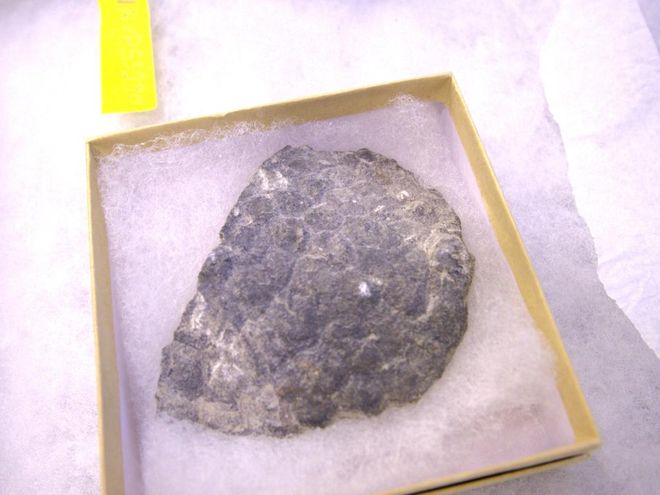
Preserved Edmontosaurus scale
(Image Courtesy of Sumner Brown Gibbs/ORNL, U.S. Dept. of Energy)
The team’s other samples included amber, smaller bones, a rib from another dinosaur and preserved Edmontosaurus scales. The researchers are using these to study the preservation of soft tissue in different kinds of remains.
"People often think of neutrons as tools for studying batteries or advanced materials, but they're just as innovative for answering questions about ancient life," said instrument scientist Hassina Bilheux.
The researchers are still analyzing the neutron scans and plan to study injuries and signs of disease in other fossils. Comparing those findings with modern animals could help them understand how different species healed broken bones.
More blood flows through an injured area as a bone heals, which could make old fractures good places to search for preserved vessels in other fossils.
Those vessels preserve signs of a recovery Scotty never got to finish.
Read More: Rare Fossilized Teeth Fill a Major Gap in Early Mammal Evolution After the Dinosaur Extinction
Article Sources
Our writers at Discovermagazine.com use peer-reviewed studies and high-quality sources for our articles, and our editors review for scientific accuracy and editorial standards. Review the sources used below for this article:
- This article references information from the Canadian Light Source: Scotty’s rib: University of Regina PhD student examines preserved blood vessels in famous fossil
- This article references information from the ORNL: ORNL neutron bone imaging brings T. rex to life
- This article references information from a study published in Scientific Reports: In situ analysis of vascular structures in fractured Tyrannosaurus rex rib